How Much Does It Cost to Have a Baby in Brooklyn, Ny
The Loftier Price of Having a Infant in America
The average delivery now costs more than $four,500—fifty-fifty with insurance.
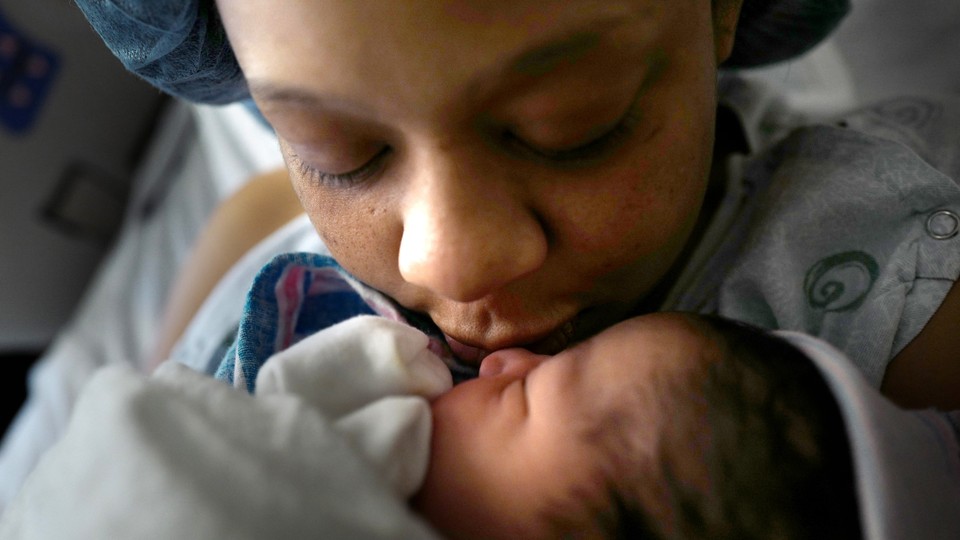
For women in many developed countries, having the baby—not paying for it—is the hard part. Giving nascence in Finland, for case, volition set y'all back a petty less than $sixty. But in the U.Due south., the average new female parent with insurance will pay more than $iv,500 for her labor and delivery, a new report in Health Affairs has institute.
For the written report, researchers at the University of Michigan looked at 657,061 American women who had wellness insurance through their jobs and who gave nativity betwixt 2008 and 2015. (All costs were adjusted for aggrandizement, and 2015 was the almost recent yr for which data were available.) They analyzed the insurance claims data for the cost of all the treatments and services the women used during the year prior to their delivery, during the commitment itself, and for three months after—to account for whatever health services that might accept affected their pregnancy outcomes.
Vaginal deliveries, the researchers found, cost women an average of nigh $four,314 out of pocket in 2015, up from $two,910 in 2008. The out-of-pocket cost of a cesarean birth, meanwhile went up from $3,364 to $5,161. The $iv,500, meanwhile, was the average for all deliveries in 2015.
"I don't accept many patients who have that kind of greenbacks only lying effectually," says Michelle Moniz, an obstetrician-gynecologist at the University of Michigan's Von Voigtlander Women's Hospital and the lead author of the study. "I sometimes meet patients struggling to afford their health intendance and sometimes choosing not to obtain health intendance because they can't afford it."
It wasn't that the procedures or technologies involved in childbirth became that much more expensive over time. The reason for the increase, according to the written report authors, is the rise in high deductibles—the lump sums that insurance companies make their customers pay earlier the companies will kick in any money. Indeed, more Americans take found themselves on plans with high deductibles in contempo years as employers have sought to shift health-care costs onto employees. In the new study, Moniz and her colleagues constitute that the percent of women with deductibles rose from near 69 per centum to nearly 87 percent in the seven-year fourth dimension menstruum. Women paid a greater share—about 7 percent more than—of their childbirth expenses equally a result.
In the U.S., 28 percent of insured workers are now on plans that have a deductible of at to the lowest degree $2,000, says Usha Ranji, an acquaintance manager for women'south health policy at the Kaiser Family Foundation. "Spending on maternity intendance really tracked with the trends that nosotros've seen in individual insurance overall," she told me.
David Anderson, a research acquaintance with the Duke-Robert J. Margolis Center for Health Policy who was not involved in the study, says while this study reinforces the effect of high deductibles on American patients, information technology has some drawbacks. By including all medical care in the 12 months leading upwards to delivery, he says, the Health Affairs authors risked overestimating the childbirth-related medical expenses of the women in the study. For instance, a broken leg that a woman suffered eleven months earlier she went into labor would presumably have been included in the report. (Moniz best-selling this limitation but argues an approach that included only expenses directly related to pregnancy would have undercounted the true price, because some doctors' visits in the months leading up to childbirth would not be coded past insurers as pregnancy-related.)
The cost of having a baby tin can be specially steep for the 45 percent of women whose pregnancies are unplanned. Because they might not have been expecting a baby when they signed up for their wellness plans, they might not take set up bated the money to pay for their commitment or signed up for coverage that would take taken care of more of their delivery costs. (Childbirth is the No. 1 reason for hospitalization among American women.) What's more, the cost of the commitment is just the starting time in a serial of major changeable expenses to come. Not long later on these mothers have paid their hospital bills, they'll be shelling out for daycare, sitters, clothes, and school fees. "This is the kind of coin that causes people to get into debt," Moniz says.
This report, like many others, highlights the limits of American health insurance, including for those who are insured. Even though the Affordable Care Act brought order to the wild west of health insurance, customers can still get stuck with large bills. Some hospitals allow their doctors to pecker their patients as out-of-network providers, for example, and even a standard xx percentage co-pay on an expensive medication or treatment tin can piece of work out to hundreds of dollars.
The high cost of bearing children, in role, also helps explain why the U.S. has 1 of the highest maternal-bloodshed rates in the developed world. When women worry about paying for their labor expenses, Moniz points out, they might delay or miss certain elements of their prenatal or postpartum care. It also helps explain why American women are having babies at record low rates. Though this infant bust has many potential explanations—including declines and delays in marriage—information technology certainly doesn't assistance that having a babe costs more than than the median American woman earns in a month. Some women, in fact, might literally not be able to beget to go pregnant.
Source: https://www.theatlantic.com/health/archive/2020/01/how-much-does-it-cost-have-baby-us/604519/
0 Response to "How Much Does It Cost to Have a Baby in Brooklyn, Ny"
Postar um comentário