How3 Is Color Field Painting Different From Op Art

Color field painting is a fashion of abstract painting that emerged in New York Metropolis during the 1940s and 1950s. It was inspired past European modernism and closely related to abstract expressionism, while many of its notable early proponents were amidst the pioneering abstruse expressionists. Color field is characterized primarily by large fields of flat, solid color spread beyond or stained into the canvas creating areas of unbroken surface and a flat picture aeroplane. The move places less emphasis on gesture, brushstrokes and action in favor of an overall consistency of course and process. In color field painting "color is freed from objective context and becomes the subject field in itself."[ane]
During the belatedly 1950s and 1960s, color field painters emerged in parts of Bully United kingdom, Canada, Australia, and the United States, particularly New York, Washington, D.C., and elsewhere, using formats of stripes, targets, simple geometric patterns and references to landscape imagery and to nature.[2]
Historical roots [edit]

The focus of attention in the world of contemporary art began to shift from Paris to New York after World War II and the development of American abstruse expressionism. During the late 1940s and early 1950s Clement Greenberg was the start art critic to propose and identify a dichotomy betwixt differing tendencies within the abstruse expressionist canon. Taking consequence with Harold Rosenberg (another of import champion of abstract expressionism), who wrote of the virtues of activeness painting in his article "American Action Painters" published in the December 1952 effect of ARTnews,[4] Greenberg observed some other tendency toward all-over colour or color field in the works of several of the then-chosen "first generation" abstruse expressionists.[5]
Mark Rothko was one of the painters that Greenberg referred to as a color field painter exemplified by Magenta, Black, Green on Orange, although Rothko himself refused to attach to whatsoever characterization. For Rothko, colour was "only an musical instrument". In a sense, his best known works – the "multiforms" and his other signature paintings – are, in essence, the same expression, admitting ane of purer (or less concrete or definable, depending on the interpretation) ways, which is that of the same "bones human emotions", every bit his earlier surrealistic mythological paintings. What is common among these stylistic innovations is a business concern for "tragedy, ecstasy and doom". By 1958, whatsoever spiritual expression Rothko meant to portray on canvas, it was growing increasingly darker. His bright reds, yellows and oranges of the early on 1950s subtly transformed into dark blues, greens, grays and blacks. His final series of paintings from the mid-1960s were gray, and black with white borders, seemingly abstract landscapes of an countless dour, tundra-similar, unknown land.
Rothko, during the mid-1940s, was in the center of a crucial menstruum of transition, and he had been impressed by Clyfford Still's abstract fields of colour, which were influenced in role by the landscapes of Still's native North Dakota. In 1947, during a subsequent semester educational activity at the California School of Fine art (known today every bit the San Francisco Fine art Plant), Rothko and Still flirted with the idea of founding their own curriculum or school. Notwithstanding was considered i of the foremost color field painters – his non-figurative paintings are largely concerned with the juxtaposition of dissimilar colors and surfaces. His jagged flashes of color give the impression that one layer of color has been "torn" off the painting, revealing the colors underneath, reminiscent of stalactites and primordial caverns. Still'southward arrangements are irregular, jagged, and pitted with heavy texture and sharp surface dissimilarity as seen above in 1957D1.
Another artist whose all-time known works relate to both abstract expressionism and to colour field painting is Robert Motherwell. Motherwell'southward style of abstract expressionism, characterized past loose opened fields of painterly surfaces accompanied by loosely fatigued and measured lines and shapes, was influenced by both Joan Miró and past Henri Matisse.[6] Motherwell's Elegy to the Castilian Republic No. 110 (1971) is a pioneering piece of work of both abstruse expressionism and color field painting. While the Elegy series embodies both tendencies, his Open Series of the late 1960s, 1970s and 1980s places him firmly inside the color field campsite.[7] In 1970 Motherwell said, "Throughout my life, the 20th-century painter whom I've admired the about has been Matisse",[eight] alluding to several of his own serial of paintings that reflect Matisse's influence, most notably his Open Series that come closest to classic colour field painting.
Barnett Newman is considered one of the major figures in abstract expressionism and one of the foremost of the color field painters. Newman'south mature work is characterized past areas of colour pure and flat separated by thin vertical lines, or "zips" as Newman chosen them, exemplified by Vir Heroicus Sublimis in the collection of MoMA. Newman himself thought that he reached his fully mature style with the Onement series (from 1948) seen here.[9] The zips define the spatial construction of the painting while simultaneously dividing and uniting the composition. Although Newman'south paintings appear to be purely abstract, and many of them were originally untitled, the names he subsequently gave them hinted at specific subjects being addressed, often with a Jewish theme. Two paintings from the early 1950s, for instance, are chosen Adam and Eve (see Adam and Eve), and at that place are too Uriel (1954) and Abraham (1949), a very dark painting, which, in addition to beingness the name of a biblical patriarch, was also the name of Newman's father, who had died in 1947. Newman's belatedly works, such as the Who's Agape of Red, Yellowish and Blueish series, utilize vibrant, pure colors, ofttimes on very big canvases.
Jackson Pollock, Adolph Gottlieb, Hans Hofmann, Barnett Newman, Clyfford Still, Mark Rothko, Robert Motherwell, Ad Reinhardt and Arshile Gorky (in his last works) were among the prominent abstruse expressionist painters that Greenberg identified as existence connected to color field painting in the 1950s and 1960s.[x]
Although Pollock is closely associated with action painting because of his manner, technique, and his painterly 'bear upon' and his physical application of paint, art critics accept likened Pollock to both action painting and colour field painting. Another disquisitional view advanced by Clement Greenberg connects Pollock's allover canvases to the large-scale Water Lilies of Claude Monet done during the 1920s. Greenberg, art critic Michael Fried, and others have observed that the overall feeling in Pollock's nigh famous works – his drip paintings – read as vast fields of built-upwardly linear elements often reading equally vast complexes of similar valued paint skeins that read equally all over fields of colour and drawing, and are related to the mural-sized tardily Monets that are synthetic of many passages of close valued brushed and scumbled marks that also read as close valued fields of color and drawing that Monet used in building his picture surfaces. Pollock'south use of all-over limerick lend a philosophical and a concrete connection to the style the colour field painters like Newman, Rothko and Nevertheless construct their unbroken and in Still's case broken surfaces. In several paintings that Pollock painted after his classic baste painting menstruum of 1947–1950, he used the technique of staining fluid oil paint and house pigment into raw canvas. During 1951 he produced a series of semi-figurative black stain paintings, and in 1952 he produced stain paintings using color. In his November 1952 exhibition at the Sidney Janis Gallery in New York City Pollock showed Number 12, 1952, a large, masterful stain painting that resembles a brightly colored stained mural (with an overlay of broadly dripped dark pigment); the painting was caused from the exhibition by Nelson Rockefeller for his personal collection. In 1960 the painting was severely damaged by fire in the Governors Mansion in Albany that as well severely damaged an Arshile Gorky painting and several other works in the Rockefeller collection. Yet, by 1999 it had been restored and was installed in Empire State Plaza.[11] [12]
While Arshile Gorky is considered to exist 1 of the founding fathers of abstruse expressionism and a surrealist, he was too one of the first painters of the New York Schoolhouse who used the technique of "staining". Gorky created broad fields of vivid, open up, unbroken color that he used in his many of his paintings every bit grounds. In Gorky's well-nigh effective and achieved paintings between the years 1941 and 1948, he consistently used intense stained fields of color, often letting the pigment run and drip, nether and around his familiar lexicon of organic and biomorphic shapes and delicate lines. Another abstruse expressionist whose works in the 1940s call to listen the stain paintings of the 1960s and the 1970s is James Brooks. Brooks ofttimes used stain as a technique in his paintings from the late 1940s. Brooks began diluting his oil paint in order to have fluid colors with which to pour and baste and stain into the mostly raw canvas that he used. These works ofttimes combined calligraphy and abstract shapes. During the final three decades of his career, Sam Francis' style of big-calibration bright abstract expressionism was closely associated with color field painting. His paintings straddled both camps within the abstract expressionist rubric, action painting and color field painting.
Having seen Pollock'southward 1951 paintings of thinned black oil paint stained into raw canvas, Helen Frankenthaler began to produce stain paintings in varied oil colors on raw canvas in 1952. Her most famous painting from that menstruation is Mountains and Bounding main (as seen below). She is ane of the originators of the color field move that emerged in the late 1950s.[13] Frankenthaler also studied with Hans Hofmann. Hofmann's paintings are a symphony of color as seen in The Gate, 1959–1960. Hofmann was renowned not but every bit an artist but likewise as a instructor of art, both in his native Germany and later in the U.S. Hofmann, who came to the United States from Germany in the early 1930s, brought with him the legacy of Modernism. Hofmann was a young artist working in Paris who painted in that location earlier Earth War I. Hofmann worked in Paris with Robert Delaunay, and he knew firsthand the innovative piece of work of both Pablo Picasso and Henri Matisse. Matisse's work had an enormous influence on him, and on his understanding of the expressive language of color and the potentiality of brainchild. Hofmann was one of the first theorists of color field painting, and his theories were influential to artists and to critics, especially to Clement Greenberg, as well as to others during the 1930s and 1940s. In 1953 Morris Louis and Kenneth Noland were both greatly influenced by Frankenthaler's stain paintings after visiting her studio in New York Urban center. Returning to Washington, DC., they began to produce the major works that created the color field movement in the late 1950s.[14]
In 1972 so Metropolitan Museum of Fine art curator Henry Geldzahler said:
Clement Greenberg included the work of both Morris Louis and Kenneth Noland in a bear witness that he did at the Kootz Gallery in the early 1950s. Clem was the first to see their potential. He invited them up to New York in 1953, I think it was, to Helen'due south studio to run across a painting that she had simply done called Mountains and Body of water, a very, very beautiful painting, which was in a sense, out of Pollock and out of Gorky. It too was one of the outset stain pictures, one of the start big field pictures in which the stain technique was used, perchance the first ane. Louis and Noland saw the film unrolled on the floor of her studio and went back to Washington, DC., and worked together for a while, working at the implications of this kind of painting.[15] [sixteen]
Morris Louis's painting Where 1960, was a major innovation that moved abstruse expressionist painting forward in a new management toward color field and minimalism. Among Louis's major works are his various series of color field paintings. Some of his best known series are the Unfurleds, the Veils, the Florals and the Stripes or Pillars. From 1929 to 1933, Louis studied at the Maryland Found of Fine and Applied Arts (now Maryland Institute College of Art). He worked at diverse odd jobs to support himself while painting and in 1935 was president of the Baltimore Artists' Clan. From 1936 to 1940, he lived in New York and worked in the easel division of the Works Progress Administration Federal Art Project. During this period, he knew Arshile Gorky, David Alfaro Siqueiros, and Jack Tworkov, returning to Baltimore in 1940. In 1948, he started to use Magna – oil-based acrylic paints. In 1952, Louis moved to Washington, D.C., living there somewhat apart from the New York scene and working near in isolation. He and a group of artists that included Kenneth Noland were central to the development of colour field painting. The bones indicate virtually Louis'south piece of work and that of other color field painters, sometimes known as the Washington Colour School in contrast to most of the other new approaches of the belatedly 1950s and early 1960s, is that they greatly simplified the idea of what constitutes the look of a finished painting.
Noland, working in Washington, DC., was too a pioneer of the color field movement in the late 1950s who used series as important formats for his paintings. Some of Noland's major series were called Targets, Chevrons and Stripes. Noland attended the experimental Blackness Mountain College and studied art in his home state of North Carolina. Noland studied with professor Ilya Bolotowsky who introduced him to neo-plasticism and the work of Piet Mondrian. There he also studied Bauhaus theory and colour with Josef Albers[17] and he became interested in Paul Klee, specifically his sensitivity to color.[18] In 1948 and 1949 he worked with Ossip Zadkine in Paris, and in the early 1950s met Morris Louis in Washington, DC.[nineteen]
In 1970 art critic Clement Greenberg said:
I'd place Pollock along with Hofmann and Morris Louis in this country amid the very greatest painters of this generation. I actually don't think there was anyone in the same generation in Europe quite to match them. Pollock didn't like Hofmann's paintings. He couldn't make them out. He didn't take the trouble to. And Hofmann didn't like Pollock's allover paintings, nor could most of Pollock's artist friends make head or tail out of them, the things he did from 1947 to '50. Simply Pollock's paintings live or die in the same context as Rembrandt's or Titian's or Velázquez's or Goya'south or David's or ... or Manet's or Ruben'southward or Michelangelo'south paintings. There's no interruption, there's no mutation hither. Pollock asked to be tested by the aforementioned eye that could see how skilful Raphael was when he was practiced or Piero when he was practiced.[20]
Color field motion [edit]
By the tardily 1950s and early 1960s young artists began to break away stylistically from abstract expressionism; experimenting with new means of making pictures; and new ways of treatment paint and color. In the early 1960s several and various new movements in abstract painting were closely related to each other, and superficially were categorized together; although they turned out to be profoundly different in the long run. Some of the new styles and movements that appeared in the early on 1960s as responses to abstract expressionism were called: Washington Color Schoolhouse, hard-edge painting, geometric abstraction, minimalism, and color field.
Factor Davis also was a painter known peculiarly for paintings of vertical stripes of color, like Black Grey Beat out, 1964, and he also was a member of the group of abstract painters in Washington, D.C. during the 1960s known as the Washington Color School. The Washington painters were among the most prominent of the mid-century color field painters.
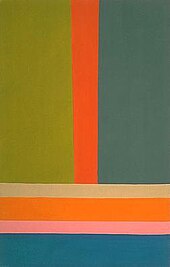
Jack Bush, Big A, 1968. Bush was a Canadian abstruse expressionist painter, born in Toronto, Ontario in 1909. He became closely tied to the two movements that grew out of the efforts of the abstract expressionists: color field painting and lyrical abstraction.[21]
The artists associated with the color field movement during the 1960s were moving away from gesture and malaise in favor of clear surfaces and gestalt. During the early to mid-1960s color field painting was the term for the piece of work of artists similar Anne Truitt, John McLaughlin, Sam Francis, Sam Gilliam, Thomas Downing, Ellsworth Kelly, Paul Feeley, Friedel Dzubas, Jack Bush, Howard Mehring, Cistron Davis, Mary Pinchot Meyer, Jules Olitski, Kenneth Noland, Helen Frankenthaler, Robert Goodnough, Ray Parker, Al Held, Emerson Woelffer, David Simpson, and others whose works were formerly related to second generation abstruse expressionism; and also to younger artists like Larry Poons, Ronald Davis, Larry Zox, John Hoyland, Walter Darby Bannard and Frank Stella. All were moving in a new management away from the violence and anxiety of activity painting toward a new and seemingly calmer language of color.
Although color field is associated with Clement Greenberg, Greenberg really preferred to use the term post-painterly brainchild. In 1964, Cloudless Greenberg curated an influential exhibition that traveled the country called post-painterly abstraction.[22] The exhibition expanded the definition of color field painting. Color field painting clearly pointed toward a new management in American painting, away from abstruse expressionism. In 2007 curator Karen Wilkin curated an exhibition called Color Every bit Field: American Painting 1950–1975 that traveled to several museums throughout the United States. The exhibition showcased several artists representing two generations of color field painters.[23]
In 1970 painter Jules Olitski said:
I don't know what Color Field painting means. I think it was probably invented by some critic, which is okay, merely I don't think the phrase ways anything. Colour Field painting? I mean, what is color? Painting has to do with a lot of things. Color is among the things it has to exercise with. It has to do with surface. It has to do with shape, Information technology has to exercise with feelings which are more hard to get at.[24]
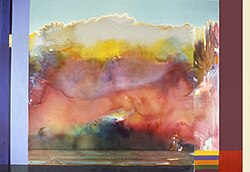
Ronnie Landfield, Rite of Jump, 1985. Landfield's piece of work emerged during the 1960s. His works are reflections of both Chinese landscape painting and the color field idiom. His paintings bridge color field painting with lyrical brainchild.[25]
Jack Bush-league was a Canadian abstract expressionist painter, built-in in Toronto, Ontario in 1909. He was a fellow member of Painters Eleven, the group founded past William Ronald in 1954 to promote abstract painting in Canada, and was shortly encouraged in his art by the American art critic Clement Greenberg. With encouragement from Greenberg, Bush became closely tied to two movements that grew out of the efforts of the abstruse expressionists: colour field painting and lyrical abstraction. His painting Big A is an example of his color field paintings of the late 1960s.[21] [27]
During the late 1950s and early 1960s Frank Stella was a meaning figure in the emergence of minimalism, post-painterly abstraction and color field painting. His shaped canvases of the 1960s similar Harran II, 1967, revolutionized abstruse painting. One of the most important characteristics of Stella's paintings is his apply of repetition. His Black Pin Stripe paintings of 1959 startled and shocked an art world that was unused to seeing monochromatic and repetitive images, painted flat, with almost no inflection. During the early 1960s Stella made several series' of notched Aluminum Paintings and shaped Copper Paintings before making multi-colored and asymmetrical shaped canvases of the tardily 1960s. Frank Stella'southward approach and relationship to color field painting was not permanent or central to his creative output; as his work became more and more three-dimensional after 1980.
In the late 1960s Richard Diebenkorn began his Ocean Park series; created during the terminal 25 years of his career and they are of import examples of color field painting. The Bounding main Park series exemplified by Ocean Park No.129, connects his before abstract expressionist works with Color field painting. During the early 1950s, Richard Diebenkorn was known as an abstract expressionist, and his gestural abstractions were shut to the New York Schoolhouse in sensibility but firmly based in the San Francisco abstract expressionist sensibility; a place where Clyfford Still has a considerable influence on younger artists by virtue of his teaching at the San Francisco Art Institute.
By the mid-1950s, Richard Diebenkorn forth with David Park, Elmer Bischoff and several others formed the Bay Area Figurative Schoolhouse with a return to Figurative painting. During the period betwixt the autumn 1964 and the spring of 1965 Diebenkorn traveled throughout Europe, he was granted a cultural visa to visit and view Henri Matisse paintings in important Soviet museums. He traveled to the then Soviet Spousal relationship to report Henri Matisse paintings in Russian museums that were rarely seen exterior of Russia. When he returned to painting in the Bay Area in mid-1965 his resulting works summed upwardly all that he had learned from his more than a decade as a leading figurative painter.[28] [29] When in 1967 he returned to abstraction his works were parallel to movements like the colour field movement and lyrical abstraction but he remained independent of both.
During the late 1960s Larry Poons whose earlier Dot paintings were associated with Op Art began to produce looser and more free formed paintings that were referred to as his Lozenge Ellipse paintings of 1967–1968. Forth with John Hoyland, Walter Darby Bannard, Larry Zox, Ronald Davis, Ronnie Landfield, John Seery, Pat Lipsky, Dan Christensen[30] and several other young painters a new move that related to color field painting began to grade; eventually called lyrical abstraction.[31] [32] [33] The late 1960s saw painters turning to surface inflection, deep space depiction, and painterly touch and pigment handling merging with the linguistic communication of colour. Amid a new generation of abstract painters who emerged combining color field painting with expressionism, the older generation likewise began infusing new elements of complex space and surface into their works. By the 1970s Poons created thick-skinned, cracked and heavy paintings referred to as Elephant Skin paintings; while Christensen sprayed loops, colored webs of lines and calligraphy, across multi-colored fields of delicate grounds; Ronnie Landfield'southward stained ring paintings are reflections of both Chinese landscape painting and the color field idiom, and John Seery's stained painting as exemplified past East, 1973, from the National Gallery of Commonwealth of australia. Poons, Christensen, Davis, Landfield, Seery, Lipsky, Zox and several others created paintings that bridge colour field painting with lyrical abstraction and underscore a re-accent on mural, gesture and touch.[26] [34] [35]
Overview [edit]
Color field painting is related to post-painterly brainchild, suprematism, abstract expressionism, hard-edge painting and lyrical abstraction. It initially referred to a particular type of abstract expressionism, especially the work of Mark Rothko, Clyfford Nevertheless, Barnett Newman, Robert Motherwell, Adolph Gottlieb and several serial of paintings by Joan Miró. Art critic Cloudless Greenberg perceived color field painting equally related to but unlike from action painting.
An important distinction that made colour field painting unlike from abstract expression was the paint handling. The most basic fundamental defining technique of painting is application of pigment and the color field painters revolutionized the way paint could exist effectively practical.
Color field painting sought to rid art of superfluous rhetoric. Artists like Barnett Newman, Mark Rothko, Clyfford Yet, Adolph Gottlieb, Morris Louis, Jules Olitski, Kenneth Noland, Friedel Dzubas, and Frank Stella, and others frequently used greatly reduced formats, with cartoon essentially simplified to repetitive and regulated systems, bones references to nature, and a highly articulated and psychological employ of color. In full general these artists eliminated overt recognizable imagery in favor of brainchild. Sure artists quoted references to by or present fine art, but in full general color field painting presents abstraction every bit an end in itself. In pursuing this direction of modern art, these artists wanted to present each painting as ane unified, cohesive, monolithic image often within series' of related types.
In distinction to the emotional energy and gestural surface marks and paint treatment of abstract expressionists such as Jackson Pollock and Willem de Kooning, color field painting initially appeared to be cool and austere. Color field painters efface the individual marker in favor of large, flat, stained and soaked areas of colour, considered to be the essential nature of visual abstraction along with the actual shape of the canvas, which Frank Stella in particular achieved in unusual ways with combinations of curved and straight edges. However, colour field painting has proven to be both sensual and deeply expressive albeit in a unlike way from gestural abstract expressionism. Denying connection to abstract expressionism or whatever other Art Motion Mark Rothko spoke conspicuously about his paintings in 1956:
I am not an abstractionist ... I am non interested in the relationship of color or form or anything else. ... I'm interested but in expressing basic human emotions — tragedy, ecstasy, doom and so on — and the fact that a lot of people intermission downwardly and cry when confronted with my pictures prove that I communicate those basic human emotions. ... The people who weep before my pictures are having the same religious experience I had when I painted them. And if you lot, equally you say, are moved only by their colour relationships, then you miss the signal![36]
Stain painting [edit]
Joan Miró was one of the first and most successful stain painters. Although staining in oil was considered unsafe to cotton fiber canvas in the long run, Miró'southward example during the 1920s, 1930s and 1940s was an inspiration and an influence on the younger generation. One of the reasons for the success of the color field motility was the technique of staining. Artists would mix and dilute their pigment in buckets or coffee cans making a fluid liquid and and then they would pour information technology into raw unprimed canvas, generally cotton duck. The paint could likewise be brushed on or rolled on or thrown on or poured on or sprayed on, and would spread into the fabric of the canvas. More often than not artists would draw shapes and areas as they stained. Many unlike artists employed staining every bit the technique of choice to use in making their paintings. James Brooks, Jackson Pollock, Helen Frankenthaler, Morris Louis, Paul Jenkins and dozens of other painters found that pouring and staining opened the door to innovations and revolutionary methods of cartoon and expressing meaning in new means. The number of artists who stained in the 1960s profoundly increased with the availability of acrylic pigment. Staining acrylic pigment into the fabric of cotton duck canvass was more benign and less damaging to the textile of the canvas than the utilize of oil pigment. In 1970 artist Helen Frankenthaler commented nigh her employ of staining:
When I first started doing the stain paintings, I left large areas of sail unpainted, I think, because the canvas itself acted as forcefully and every bit positively as paint or line or color. In other words, the very basis was role of the medium, so that instead of thinking of information technology equally background or negative infinite or an empty spot, that area did not demand paint because it had paint next to it. The thing was to decide where to leave it and where to fill up it and where to say this doesn't need some other line or another pail of colors. It's proverb it in space.[37]
Spray painting [edit]
Surprisingly few artists used the spray gun technique to create big expanses and fields of color sprayed across their canvases during the 1960s and 1970s. Some painters who effectively used spray painting techniques include Jules Olitski, who was a pioneer in his spray technique that covered his big paintings with layer later on layer of different colors, ofttimes gradually changing hue and value in subtle progression. Another important innovation was Dan Christensen's use of a spray technique to peachy effect in loops and ribbons of vivid color; sprayed in clear, calligraphic marks beyond his large-scale paintings. William Pettet, Richard Saba, and Albert Stadler, used the technique to create large-calibration fields of multi-colors; while Kenneth Showell sprayed over crumpled canvases and created an illusion of abstruse still-life interiors. Most of the spray painters were active especially during the belatedly 1960s and 1970s.
Stripes [edit]
Stripes were one of the near popular vehicles for color used by several different color field painters in a multifariousness of different formats. Barnett Newman, Morris Louis, Jack Bush, Gene Davis, Kenneth Noland and David Simpson, all made important Series' of stripe paintings. Although he did not call them stripes but zips Barnett Newman'due south stripes were mostly vertical, of varying widths and sparingly used. In Simpson and Noland'due south case their stripe paintings were all mostly horizontal, while Factor Davis painted vertical stripe paintings and Morris Louis generally painted vertical stripe paintings sometimes called Pillars. Jack Bush tended to practise both horizontal and vertical stripe paintings every bit well as angular ones.
Magna paint [edit]
Magna, a special artist utilise acrylic paint was adult by Leonard Bocour and Sam Golden in 1947 and reformulated in 1960, specifically for Morris Louis and other stain painters of the colour field movement.[38] In Magna pigments are ground in an acrylic resin with alcohol-based solvents.[39] Unlike modern h2o-based acrylics, Magna is miscible with turpentine or mineral spirits and dries rapidly to a matte or sleeky stop. It was used extensively by Morris Louis, and Friedel Dzubas and also past Popular artist Roy Lichtenstein. Magna colors are more bright and intense than regular acrylic water-based paints. Louis used Magna to great effect in his Stripe Series,[40] where the colors are used undiluted and are poured unmixed directly from the can.[41]
Acrylic paint [edit]
In 1972, quondam Metropolitan Museum of Art curator Henry Geldzahler said:
Colour field, curiously enough or perhaps not, became a feasible way of painting at exactly the time that acrylic paint, the new plastic paint, came into being. It was as if the new paint demanded a new possibility in painting, and the painters arrived at it. Oil paint, which has a medium that is quite different, which isn't water-based, always leaves a slick of oil, or pool of oil, around the edge of the color. Acrylic paint stops at its ain edge. Color field painting came in at the same time as the invention of this new pigment.[42]
Acrylics were first made commercially available in the 1950s as mineral spirit-based paints chosen Magna[43] offered by Leonard Bocour. Water-based acrylic paints were subsequently sold every bit "latex" house paints, although acrylic dispersion uses no latex derived from a rubber tree. Interior "latex" firm paints tend to be a combination of binder (sometimes acrylic, vinyl, pva and others), filler, pigment and water. Exterior "latex" house paints may also be a "co-polymer" alloy, only the very all-time exterior water-based paints are 100% acrylic.
Soon after the water-based acrylic binders were introduced equally house paints, both artists – the get-go of whom were Mexican muralists – and companies began to explore the potential of the new binders. Acrylic creative person paints tin can exist thinned with h2o and used as washes in the style of watercolor paints, although the washes are fast and permanent once dry out. Water-soluble artist-quality acrylic paints became commercially available in the early on 1960s, offered by Liquitex and Bocour under the trade name of Aquatec. Water-soluble Liquitex and Aquatec proved to exist ideally suited for stain painting. The staining technique with water-soluble acrylics made diluted colors sink and concur fast into raw canvass. Painters such as Kenneth Noland, Helen Frankenthaler, Dan Christensen, Sam Francis, Larry Zox, Ronnie Landfield, Larry Poons, Jules Olitski, Cistron Davis, Ronald Davis, Sam Gilliam and others successfully used h2o-based acrylics for their new stain, color field paintings.[44]
Legacy: influences and influenced [edit]

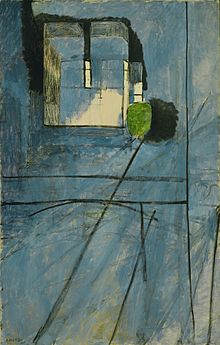
The painterly legacy of 20th-century painting is a long and intertwined mainstream of influences and complex interrelationships. The use of big opened fields of expressive color applied in generous painterly portions, accompanied by loose drawing (vague linear spots and/or figurative outline) can get-go be seen in the early 20th-century works of both Henri Matisse and Joan Miró. Matisse and Miró, likewise as Pablo Picasso, Paul Klee, Wassily Kandinsky, and Piet Mondrian direct influenced the abstruse expressionists, the color field painters of postal service-painterly abstraction and the lyrical abstractionists. Belatedly 19th-century Americans similar Augustus Vincent Tack and Albert Pinkham Ryder, along with early American Modernists like Georgia O'Keeffe, Marsden Hartley, Stuart Davis, Arthur Dove, and Milton Avery'south landscapes too provided important precedents and were influences on the abstract expressionists, the color field painters, and the lyrical abstractionists. Matisse paintings French Window at Collioure, and View of Notre-Matriarch [45] both from 1914 exerted tremendous influence on American color field painters in general, (including Robert Motherwell's Open Series), and on Richard Diebenkorn's Ocean Park paintings specifically. According to fine art historian Jane Livingston, Diebenkorn saw both Matisse paintings in an exhibition in Los Angeles in 1966, and they had an enormous impact on him and his piece of work.[46] Jane Livingston says most the January 1966 Matisse exhibition that Diebenkorn saw in Los Angeles:
It is difficult non to ascribe enormous weight to this experience for the direction his work took from that time on. Two pictures he saw there reverberate in almost every Ocean Park sheet. View of Notre Dame and French Window at Collioure, both painted in 1914, were on view for the first time in the US.[46]
Livingston goes on to say "Diebenkorn must have experienced French Window at Collioure, equally an epiphany."[47]
Miró was i of the almost influential artists of the 20th century. He pioneered the technique of staining; creating blurry, multi-colored cloudy backgrounds in thinned oil paint throughout the 1920s and 1930s; on top of which he added his calligraphy, characters and arable dictionary of words, and imagery. Arshile Gorky openly admired Miró'south work and painted Miró-similar paintings, before finally discovering his own originality in the early on 1940s. During the 1960s Miró painted big (abstruse expressionist scale) radiant fields of vigorously brushed paint in blue, in white, and other monochromatic fields of colors; with blurry black orbs and calligraphic rock-like shapes, floating at random. These works resembled the color field paintings of the younger generation. Biographer Jacques Dupin said this about Miró's work of the early 1960s:
These canvases disembalm affinities – Miró does non in the least attempt to deny this – with the researches of a new generation of painters. Many of these, Jackson Pollock for i, have acknowledged their debt to Miró. Miró in turn displays lively interest in their work and never misses an opportunity to encourage and support them. Nor does he consider it beneath his dignity to utilise their discoveries on some occasions.[48]
Taking its case from other European modernists similar Miró, the color field movement encompasses several decades from the mid 20th century through the early 21st century. Color field painting actually encompasses iii separate but related generations of painters. Normally used terms to refer to the three separate just related groups are abstract expressionism, post-painterly abstraction, and lyrical abstraction. Some of the artists made works in all three eras, that relate to all of the three styles. Colour field pioneers such as Jackson Pollock, Mark Rothko, Clyfford All the same, Barnett Newman, John Ferren, Adolph Gottlieb, and Robert Motherwell are primarily thought of as abstract expressionists. Artists similar Helen Frankenthaler, Sam Francis, Richard Diebenkorn, Jules Olitski, and Kenneth Noland were of a slightly younger generation, or in the instance of Morris Louis aesthetically aligned with that generation'southward point of view; that started out as abstract expressionists but rapidly moved to post-painterly brainchild. While younger artists like Frank Stella, Ronald Davis, Larry Zox, Larry Poons, Walter Darby Bannard, Ronnie Landfield, Dan Christensen, began with mail service-painterly abstraction and eventually moved frontward towards a new type of expressionism, referred to as lyrical abstraction. Many of the artists mentioned, besides as many others, have practiced all iii modes at one phase of their careers or another. During the later phases of colour field painting; as reflections of the zeitgeist of the late 1960s (in which everything began to hang loose) and the angst of the age (with all of the uncertainties of the time) merged with the gestalt of post-painterly brainchild, producing lyrical abstraction which combined precision of the color field idiom with the malerische of the abstract expressionists. During the same menses of the tardily 1960s, and early 1970s in Europe, Gerhard Richter, Anselm Kiefer[49] and several other painters also began producing works of intense expression, merging abstraction with images, incorporating landscape imagery, and figuration that past the late 1970s was referred to equally Neo-expressionism.
Painters [edit]
The following is a list of colour field painters, closely related artists and some of their more of import influences:
See also [edit]
- Abstract art
- Abstract Imagists
- Physical art
- Hard-edge painting
- Lyrical abstraction
- Modern art
- Post-painterly abstraction
- Warming stripes (data visualization technique using the color field concept)
- Washington Colour School
- Western painting
References [edit]
- ^ "Themes in American Fine art: Abstraction". National Gallery of Art. Archived from the original on June 8, 2011. Retrieved June eleven, 2011. .
- ^ "Colour Field Painting". Tate. Retrieved May 2, 2014
- ^ Emile De Antonio, Painters Painting, a Candid History of The Modern Art Scene 1940–1970, P.44, Abbeville Press 1984, ISBN 0-89659-418-i
- ^ Harold Rosenberg Archived 2012-01-fourteen at the Wayback Car. National Portrait Gallery, Smithsonian Institution. Retrieved 22 February 2008.
- ^ "Color Every bit Field: American Painting". The New York Times. Retrieved December seven, 2008.
- ^ De Antonio, Emile. Painters Painting, a Candid History of The Modernistic Art Scene 1940–1970. Abbeville Press, 1984. 44, 61–63, 65, 68–69. ISBN 0-89659-418-i
- ^ "Open Series #121". Tate. Retrieved December vii, 2008.
- ^ De Antonio, Emile. Painters Painting, a Aboveboard History of The Mod Art Scene 1940–1970, p. 44, Abbeville Press 1984, ISBN 0-89659-418-1
- ^ Barnett Newman
- ^ "Smithsonian Museum Exhibits Colour Field Painting", retrieved December seven, 2008
- ^ Hess, Thomas B. (August 16, 1967). "A Descent Into the Mall Storm". New York. p. 66. Retrieved May 6, 2011.
- ^ Pollock #12 1952 at NY State Mall project Archived 2014-03-13 at the Wayback Machine Retrieved May vi, 2011
- ^ "'Color Field' Artists Institute a Unlike Manner" Retrieved 3 August 2010
- ^ Fenton, Terry. "Morris Louis". sharecom.ca. Retrieved Dec viii, 2008
- ^ De Antonio, Emile. Painters Painting, a Candid History of The Modern Fine art Scene 1940–1970, p. 79, Abbeville Press 1984, ISBN 0-89659-418-ane
- ^ Carmean, E. A. Helen Frankenthaler A Paintings Retrospective, Exhibition Catalog, pp. 12–twenty, Harry Northward. Abrams in conjunction with The Museum of Modern Art, Fort Worth, ISBN 0-8109-1179-5
- ^ "Bold Emblems". Time. Apr 18, 1969. Retrieved February 8, 2008.
- ^ Lempesis, Dimitris. "TRACES:Kenneth Noland". Dream thought machine.
- ^ "Morris Louis". National Gallery of Art.
- ^ De Antonio, Emile. Painters Painting, a Aboveboard History of The Modern Art Scene 1940–1970, p. 47, Abbeville Press 1984, ISBN 0-89659-418-one
- ^ a b "Jack Bush". The Art History Archive; Canadian Art. Retrieved December 9, 2008.
- ^ "Clement Greenberg". Mail service-Painterly Abstraction. Retrieved December 8, 2008.
- ^ Smith, Roberta. "Weightless Color, Floating Costless". The New York Times. March 7, 2008. Retrieved December 7, 2008.
- ^ De Antonio, Emile. Painters Painting, a Candid History of The Modern Art Scene 1940–1970, P.81, Abbeville Press 1984, ISBN 0-89659-418-1
- ^ Morgan, Robert C. Landfield's Illuminations. Exhibition Catalogue: Ronnie Landfield: Paintings From Five Decades. The Butler Institute of American Art. ISBN ane-882790-50-2
- ^ a b Peter Schjeldahl Archived June two, 2012, at the Wayback Machine] comment on John Seery]
- ^ Fenton, Terry. "Jack Bush-league". sharecom.ca. Retrieved December 9, 2008.
- ^ Livingston, Jane. "The Fine art of Richard Diebenkorn". 1997–1998 Exhibition catalog. In The Art of Richard Diebenkorn, Whitney Museum of American Art. 56. ISBN 0-520-21257-6
- ^ American Abstract and Figurative Expressionism: Mode Is Timely Art Is Timeless (New York Schoolhouse Press, 2009.) ISBN 978-0-9677994-ii-i. p. 80–83
- ^ [one] Archived 2010-07-03 at the Wayback Auto retrieved June 2, 2010
- ^ Ashton, Dore. "Young Abstract Painters: Right On!". Arts vol. 44, no. 4, February, 1970. 31–35
- ^ Aldrich, Larry. Immature Lyrical Painters. Fine art in America, vol. 57, no. 6, November–December 1969. 104–113
- ^ Color Fields, Deutsche Guggenheim Archived 2010-11-20 at the Wayback Auto Retrieved Nov 26, 2010
- ^ Exhibition Catalogue, Ronnie Landfield: Paintings From 5 Decades. The Butler Institute of American Art, Seeking the Miraculous. v–6. ISBN 1-882790-50-2
- ^ Ratcliff, Carter. The New Informalists, Art News, v. 68, north. 8, Dec 1969, p.72.
- ^ Rodman, Selden. Conversations with Artists, 1957. Later published in "Notes from a conversation with Selden Rodman, 1956" in Writings on Art: Mark Rothko 2006, edited past López-Remiro, Miguel.
- ^ De Antonio, Emile. Painters Painting, a Candid History of The Mod Art Scene 1940–1970, P.82, Abbeville Printing 1984, ISBN 0-89659-418-ane
- ^ Henry, Walter. palimpsest.stanford.edu – Technical Exchange Archived October 12, 2008, at the Wayback Machine. Stanford University, Volume 11, Number 2, May 1989, 11–14. Retrieved Dec 8, 2007.
- ^ Fenton, Terry. "Appreciating Noland". Retrieved Apr 30th, 2007.
- ^ Number 182, Phillips Collection, Washington, DC., retrieved December 8, 2008 Archived Feb 28, 2009, at the Wayback Machine
- ^ Blake Gopnik, "Morris Louis: A Painter Of a Unlike Stripe". The Washington Post, retrieved Dec 8, 2008
- ^ De Antonio, Emile. Painters Painting, a Aboveboard History of The Modern Art Scene 1940–1970 Abbeville Press, 1984. 81. ISBN 0-89659-418-one
- ^ Terry Fenton online essay almost Kenneth Noland, and acrylic pigment, accessed Apr 30th, 2007
- ^ Junker, Howard. The New Art: It's Way, Fashion Out, Newsweek, July 29, 1968, pp.iii, 55–63.
- ^ a b View of Notre Dame, 1914 at MoMA, retrieved Dec 18, 2008
- ^ a b Livingston, Jane. "The Fine art of Richard Diebenkorn". In: 1997–1998 Exhibition catalog, Whitney Museum of American Fine art. 62–67. ISBN 0-520-21257-half dozen
- ^ Livingston, Jane. The Art of Richard Diebenkorn. In 1997–1998 Exhibition itemize, Whitney Museum of American Art. 64. ISBN 0-520-21257-6,
- ^ Dupin, Jacques. Joan Miró Life and Work. New York Metropolis: Harry North. Abrams, 1962. 481
- ^ "White Cube: Anselm Kiefer". White Cube. Retrieved December 15, 2008.
Sources [edit]
- Greenberg, Cloudless. Fine art and Culture, Beacon Press, 1961
- Greenberg, Clement. Late Writings, edited by Robert C. Morgan, St. Paul: Academy of Minnesota Press, 2003.
- Greenberg, Cloudless. Homemade Esthetics: Observations on Art and Taste. Oxford University Printing, 1999.
- Kleiner, Fred S.; and Mamiya, Christin J., Gardner'due south Art Through the Ages (2004). Volume 2. Wadsworth Publishing. ISBN 0-534-64091-5.
- Schwabsky, Barry. "Irreplaceable Hue – Colour Field Painting". ArtForum 1994. Expect Smart twenty April 2007.
- Color As Field: American Painting, 1950–1975, retrieved December 7, 2008
- Wilkin, Karen and Belz, Carl. Color As Field: American Painting, 1950–1975. Published: Yale University Printing; ane edition (November 29, 2007). ISBN 0-300-12023-0, ISBN 978-0-300-12023-iii
- Livingston, Jane. The Art of Richard Diebenkorn, with essays by John Elderfield, Ruth East. Fine, and Jane Livingston. The Whitney Museum of American Art, 1997, ISBN 0-520-21257-half dozen
- De Antonio, Emile and Tuchman, Mitchell. Painters Painting A Aboveboard History of The Modern Art Scene, 1940–1970, Abbeville Press 1984, ISBN 0-89659-418-1
- Jacques Dupin, Joan Miró Life and Work, Harry N. Abrams, Inc., Publisher, New York Urban center, 1962, Library of Congress Catalog Card Number: 62-19132
- Various authors: Barbara Rose, Gerald Nordland, Walter Hopps, Hardy S. George; Breaking the Mold, Selections from the Washington Gallery of Mod Fine art, 1961–1968, exhibition catalogue, Oklahoma City Museum of Art 2007, ISBN 0-911919-05-8
- Cynthia Goodman. Hans Hofmann, with essays by Irving Sandler, and Clement Greenberg; Exhibition Catalog, Whitney Museum of American Art, New York in association with Prestel-Verlag, Munich, ISBN 0-87427-070-seven
- Irving Sandler. The New York School: The Painters and Sculptors of the Fifties, Harper & Row, 1978 ISBN 0-06-438505-1
- Aldrich, Larry. Young Lyrical Painters, Art in America, five.57, n6, November–Dec 1969, pp. 104–113.
- Peter Schjeldahl. New Abstract Painting: A Variety of Feelings, Exhibition review, "Standing Abstraction", The Whitney Downtown Branch, 55 Water St. NYC. The New York Times, October 13, 1974.
- Kertess, Klaus. Peter Young Paintings 1963–1980. Parc Foundation. ISBN 978-one-931885-68-3
- Kertess, Klaus. The Nature of Paint, Ronnie Landfield:Forty Years of Colour Brainchild, Exhibition Catalog, ISBN 978-0-9820841-two-0
- Carmean, E.A. Toward Color and Field, Exhibition Catalogue, Houston Museum of Fine Arts, 1971.
- Carmean, E.A. Helen Frankenthaler A Paintings Retrospective, Exhibition Catalog, Harry Due north. Abrams in conjunction with The Museum of Mod Fine art, Fort Worth, ISBN 0-8109-1179-five
- Henning, Edward B. Colour & Field, Art International May 1971: 46–50.
- Tucker, Marcia. The Construction of Color, New York: Whitney Museum of American Art, NYC, 1971.
- Robbins, Daniel. Larry Poons: Creation of the Circuitous Surface, Exhibition Catalogue, Salander/O'Reilly Galleries, pp. ix–19, 1990.
- Michael Fried. Morris Louis, Harry Northward. Abrams, Library of Congress Number: 79-82872
External links [edit]
- Mark Jenkins, Revisiting Morris Louis's Lighter Touch retrieved December 8, 2008, Washington Postal service Review of the Morris Louis retrospective at the Hirshhorn Museum and Sculpture Garden September 2007.
- Washington Post online gallery of Morris Louis paintings
- Kreeger Museum; an expanded exhibition which also involved several museums and galleries in Washington DC and surrounding areas
- Fine art Mode: Colour Field Painting – Motility Overview on The Art Story Foundation
Source: https://en.wikipedia.org/wiki/Color_field
0 Response to "How3 Is Color Field Painting Different From Op Art"
Postar um comentário